Does the US Wine Industry Have an Export Problem?

The US wine industry, particularly in California, has been facing significant challenges since 2023, with many producers struggling financially. While there are multiple factors contributing to the current market situation, one hypothesis worth exploring is the declining export performance of US wines in the context of a rapidly globalizing wine market.
Two Graphs: US vs. the World
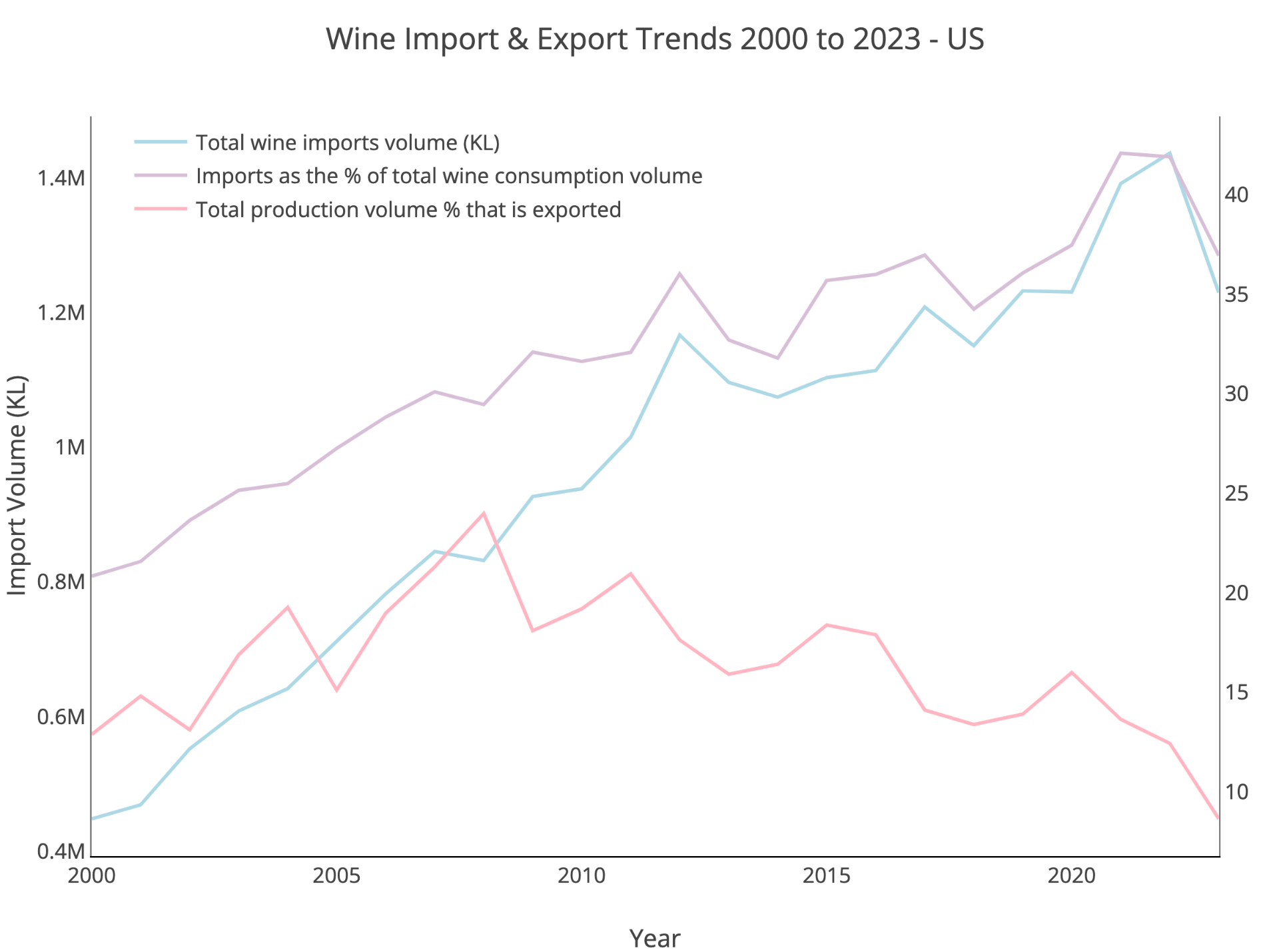
US Wine Import & Export Trends from 2000 to 2023
As of 2023, the US is now importing approximately 1.2 million kiloliters (KL) of wine, a surprisingly substantial increase from the 0.4 million KL in 2000. This growth in imports suggests a strong demand for international wines within the US, likely driven by consumers' desire for new taste experiences (and lower prices). Simultaneously, the percentage of wine imports as a proportion of total wine consumption in the US has also steadily increased, now hovering around 40%.
However, what is particularly striking is the trend in US wine exports. The total production volume that is exported has seen a significant decline over the same period. By 2023, the percentage of wine produced in the US that is exported has dropped to around 10%, down from a more stable rate in the early 2000s, which peaked in 2008 at 24%. This sharp decrease appears even more profound when compared to the global statistics.
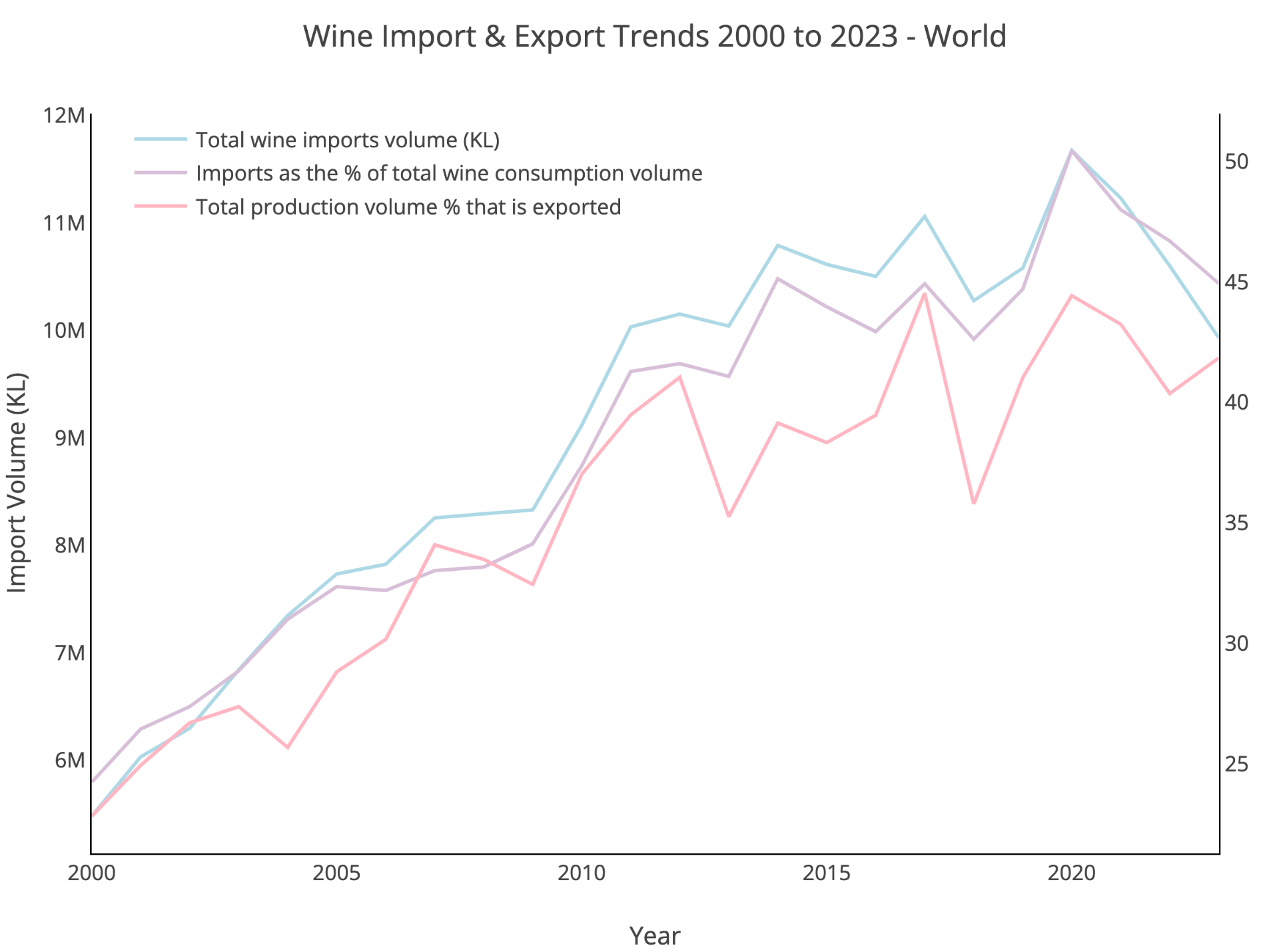
Global Wine Import & Export Trends from 2000 to 2023
The charts above provide the global perspective, showing that worldwide, like in the US, both wine imports and imports as a percentage of consumption have generally been on an upward trajectory. However, the world data suggests that most countries have continued to match rising imports with an increase in wine exports. The percentage of global wine production that is exported has consistently risen or remained stable since 2000.
This trend suggests that as the world wine market becomes more globalized, there is a rising preference among consumers worldwide for diverse wine options, but US exports are not following this global pattern; instead, they are on the decline.
Consequences for US Wineries
This divergence in export trends could be a key reason for the plummeting sales experienced by many US wineries, particularly in California. If the global wine market is increasingly demanding a wider variety of wines from different regions, the declining export performance of US wines might indicate that they are rapidly losing their competitive edge. Small US producers especially need to face the reality that Americans are not only preferring imported wines more than ever, they also have access to more foreign wines than any time in the last 25 years.
One could argue that global consumers are either shunning US wines intentionally or being priced out of the market. The declining export percentages may point to several possible issues: a mismatch between US wine styles and global consumer preferences, or perhaps the notoriously high prices of California wines, which could be pushing buyers towards more competitively priced alternatives from other regions.
Where to Look Next
Are US wines being overshadowed by more affordable or better-marketed wines from other regions? Is the decline in exports due to stylistic preferences, where global consumers prefer the profiles offered by wines from other countries? Or is it primarily an issue of pricing, with US wines, especially those from California, priced out of reach for many international consumers?
Data Source: Anderson, K. and V. Pinilla (with the assistance of A.J. Holmes), Annual Database of Global Wine Markets, 1835 to 2023, University of Adelaide's Wine Economics Research Centre, August 2024.